One of nature's most versatile plants.
We build the adaptive system to grow it for the real world — outdoors, in real water and weather, not under lab lights.
Almost everything we know about duckweed, we learned indoors.
A plant that has to perform in the real world meets real water, real weather, and real systems. We're built for that gap — not to dismiss the lab, but to complete it.
Controlled. Small-sample. Indoors.
Clean light, clean water, short runs — much of it under artificial lighting that costs more than the crop can return at scale. Essential science, but a different question from deployment.
This water. This sky. This scale.
Real conditions, and sunlight that's free. The answers diverge from the lab — and that divergence is exactly what the system is built to learn.
Look what we already ask of one plant.
Across the published literature, duckweed turns up almost everywhere — cleaning water, feeding fish, making fuel, even tested for life-support in space. This maps the areas of research already established on it; the lopsidedness is the story. Meet the family →
It isn't one plant. It's a family.
About 37 species across five genera — and what separates them is physical: how big the fronds grow, and how many roots (if any) they trail. From Spirodela the size of a fingernail to rootless Wolffia grains smaller than a pinhead. A couple of these our vision system can already tell apart in a live tray.
The giants of the family — the broadest fronds, a fan of several roots per frond, and reddish-purple undersides. Where Lemna trails one root, Spirodela trails a bundle.
The family's largest frond, many roots, and starch-rich overwintering turions — a model for high-starch biomass.
- Spirodela intermediaOverlaps S. polyrhiza with far less literature — little to add for our current questions.
A one-species genus that sits between Spirodela and Lemna: smaller than Spirodela, but with a small cluster of roots (2–7) rather than Lemna's single one, and dotted red undersides.
A standout starch accumulator and nutrient-recovery workhorse — and one our vision system can already tell apart.
The whole genus is already in our knowledge base.
The most familiar duckweeds: flat oval fronds, each with exactly one dangling root. The genus science understands best — and the one that anchors most of our knowledge base.
The lab standard — flat, thin, symmetrical fronds. The most-studied duckweed on Earth and our baseline for growth, stress and nutrient removal.
Its underside swells with spongy air tissue, so it rides higher on the water than L. minor — a classic comparator.
A tiny invasive Lemna that exploits bright light better than L. minor — and another our vision can identify.
The subject of published third-party high-oil (TAG) genetic work — an exploratory lipid frontier.
- Lemna trisulcaGrows submerged in branching chains — a different habit from our floating-mat focus.
- Lemna turioniferaClose to L. minor and thinly studied for the routes we care about.
- Lemna aequinoctialisFast and pantropical, but near L. minor's profile for our current questions.
- Lemna valdivianaThin literature; nothing distinct for our routes yet.
- Lemna obscuraEasily confused with L. minor and adds little beyond it.
- Lemna perpusillaSparse data and no clear edge over the Lemna we already study.
- Lemna teneraRarely cultivated and poorly documented.
- Lemna dispermaAustralasian; outside the conditions we work in for now.
- Lemna yungensisRecently described, with almost no literature to build on.
Rootless and slender — strap- or tongue-shaped fronds that hang just beneath the surface rather than sitting flat on it. The genus is thinly studied everywhere, not just by us.
The genus's high-protein edge case — the one Wolffiella with real composition data behind it.
- Wolffiella gladiataThinly documented; overlaps our existing Wolffiella coverage.
- Wolffiella lingulataSparse literature for our questions.
- Wolffiella caudataVery little documented.
- Wolffiella denticulataRare and thinly studied.
- Wolffiella oblongaSparse data; nothing distinct for our routes.
- Wolffiella neotropicaNeotropical and barely covered in the literature.
- Wolffiella repandaRarely studied.
- Wolffiella rotundaThin literature.
- Wolffiella welwitschiiAfrican and sparsely documented.
Rootless green grains under ~1.5 mm — the smallest flowering plants on Earth. No roots, no obvious structure: just floating biomass, which makes them a compact model for growth and protein.
Among the smallest flowering plants alive; eaten as 'khai-nam' and the fastest grower in the axenic screens.
A rootless grain that reaches notably high protein content in controlled culture.
- Wolffia angustaVery small and thinly studied.
- Wolffia australianaAustralian, with little data for our routes.
- Wolffia borealisNot distinct from the Wolffia we study, for our questions.
- Wolffia brasiliensisNeotropical and thinly studied.
- Wolffia columbianaOverlaps our two Wolffia for our current questions.
- Wolffia cylindraceaSparse literature.
- Wolffia elongataRare and narrowly distributed.
- Wolffia microscopicaKnown for its flowering biology, but almost no cultivation data.
- Wolffia neglectaSparse data; nothing distinct yet.
Today we're investigating 9 of about 37 species — the rest may fold in over time, as the science or a downstream route makes them worth it. Depth = papers in our knowledge base, not all literature; a single study often spans several species, so these counts overlap rather than sum.
One loop, not a catalogue of data.
AI proposes; the bench validates.The public version is deliberately simple: nouns and arrows. Detailed methods, data, and performance stay behind a real conversation.
We design the outcome in — instead of discovering it after the build.
Different goals need different systems. Because it learns from real conditions, the system can be aimed from the start — and these goals needn't always be in tension. These are the outcomes we're building toward; none is validated yet.
Nutrients and contaminants drawn down from real inputs.
Composition steered toward protein.
Or starch — matched to the downstream route.
…the aim being not to trade away growth. Real-world data is how we design those outcomes in from the start — lower cost, higher confidence.
We read the whole tray — not a sample of it.
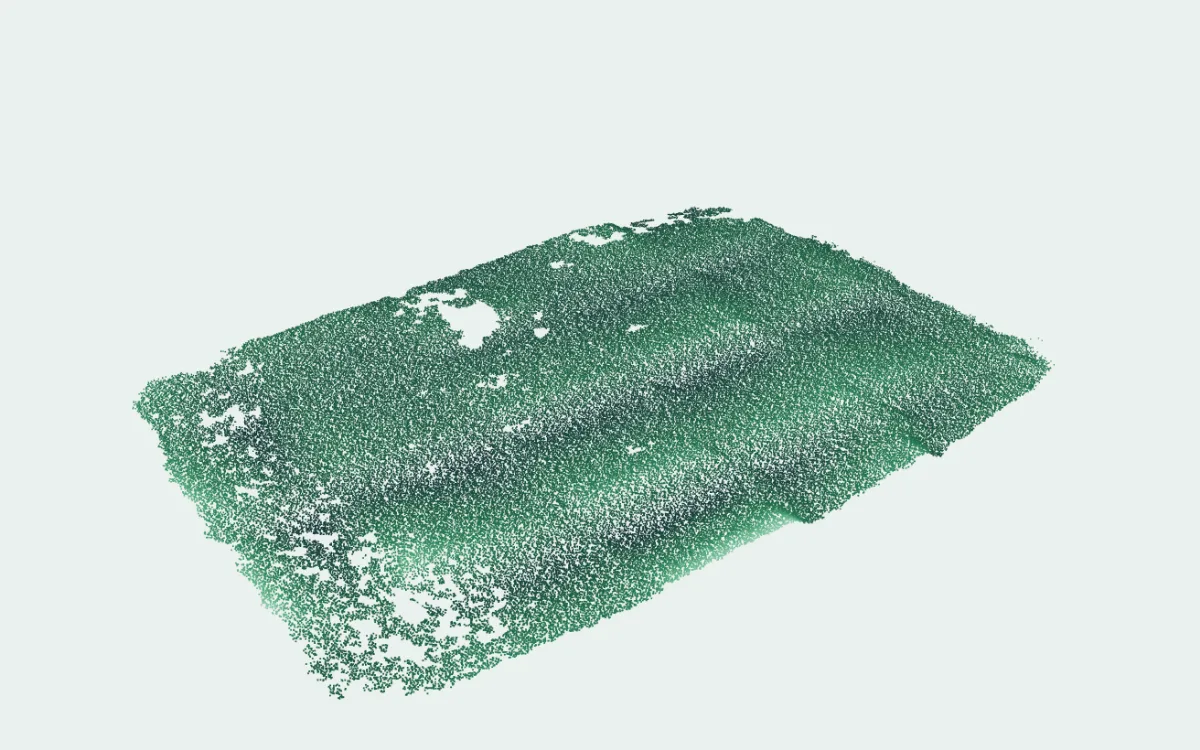
In our trials the vision pipeline takes tens of images a day and reads the tray directly. So far that means coverage and colour, measured against the conditions the crop actually needs; growth and visual-health tracking are still in development as the models mature. Below is a real tray our vision system reconstructed in 3D from a single capture, shaded by surface relief.
Capabilities, not claims.
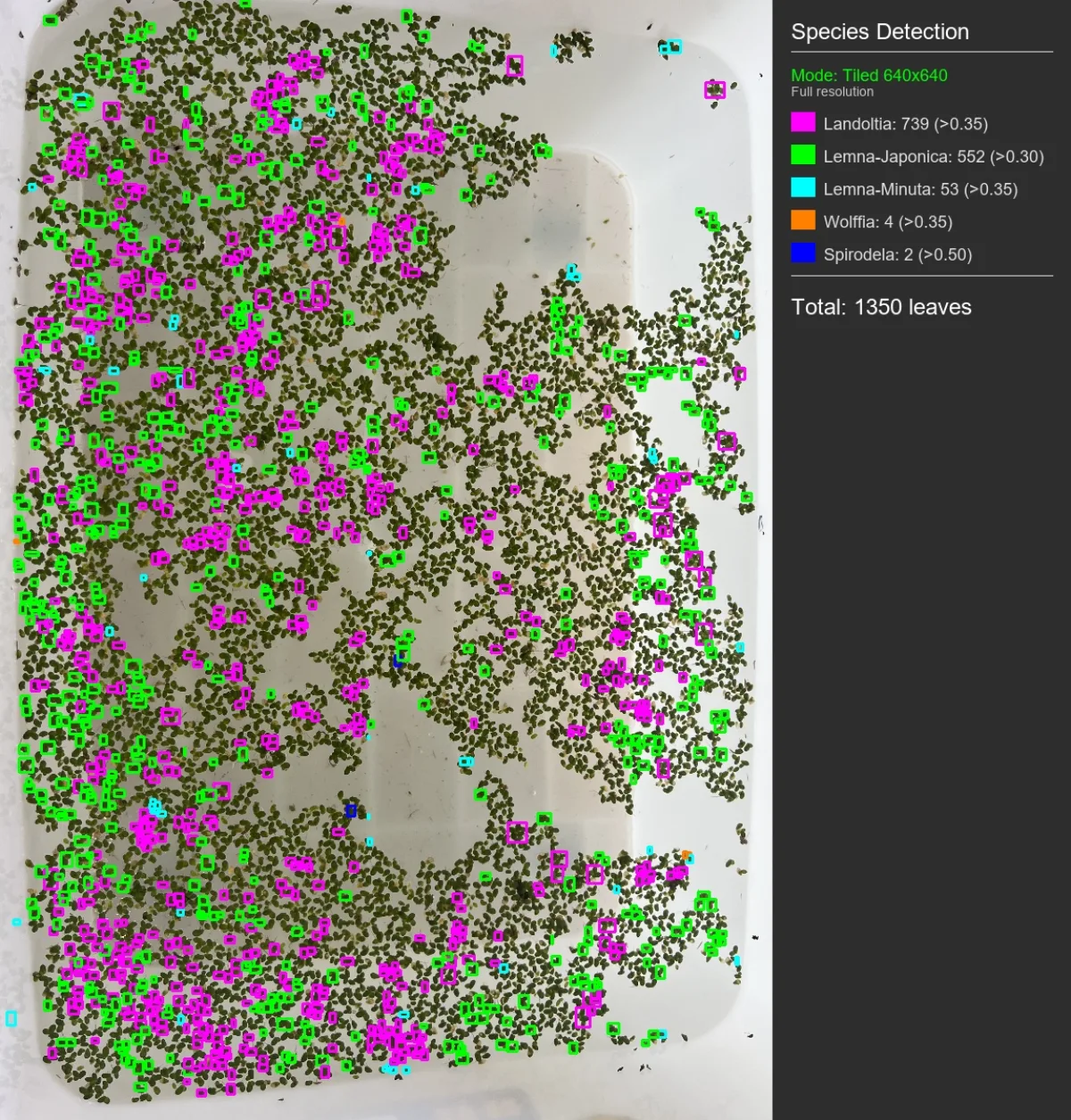
It already tells the family apart.
Not a mock-up — a real cultivation tray read by our vision model, classifying fronds by species across a single live frame. The same pipeline is being developed to read growth and stress.
See the family it identifies →Growth and health, read from imagery
Image analysis being developed to read how the mat grows and where it is stressed - turning a tray into a measured surface.
Nutrient dynamics
How nutrients move through a contained system across a growth cycle.
Light and climate modelling
We model the physical environment so each system can be engineered toward its climate.
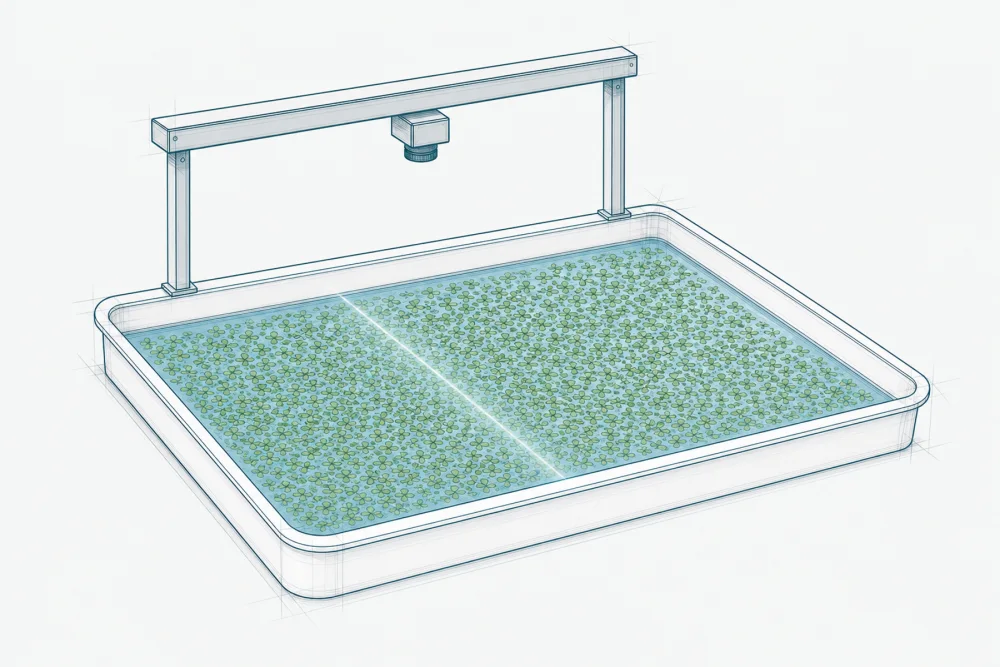
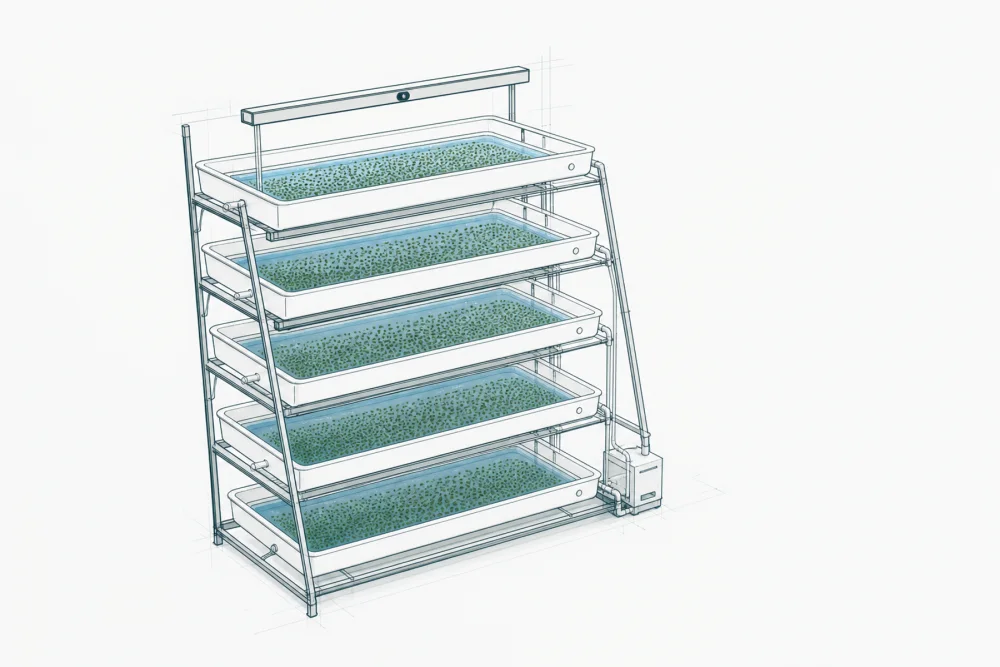
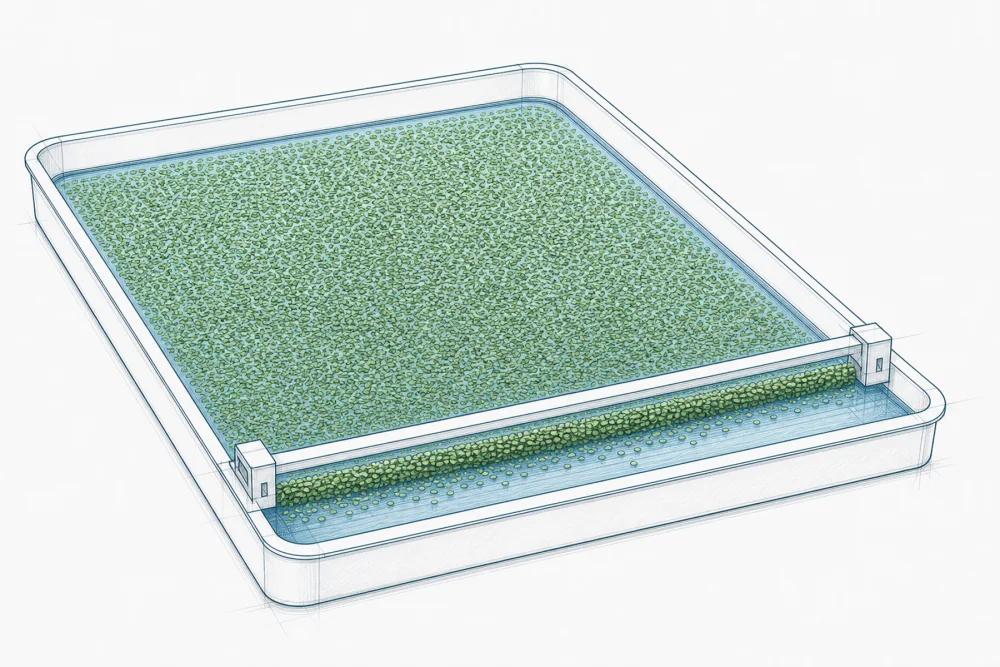
[ concept sketches · the instrumented system we're building ]
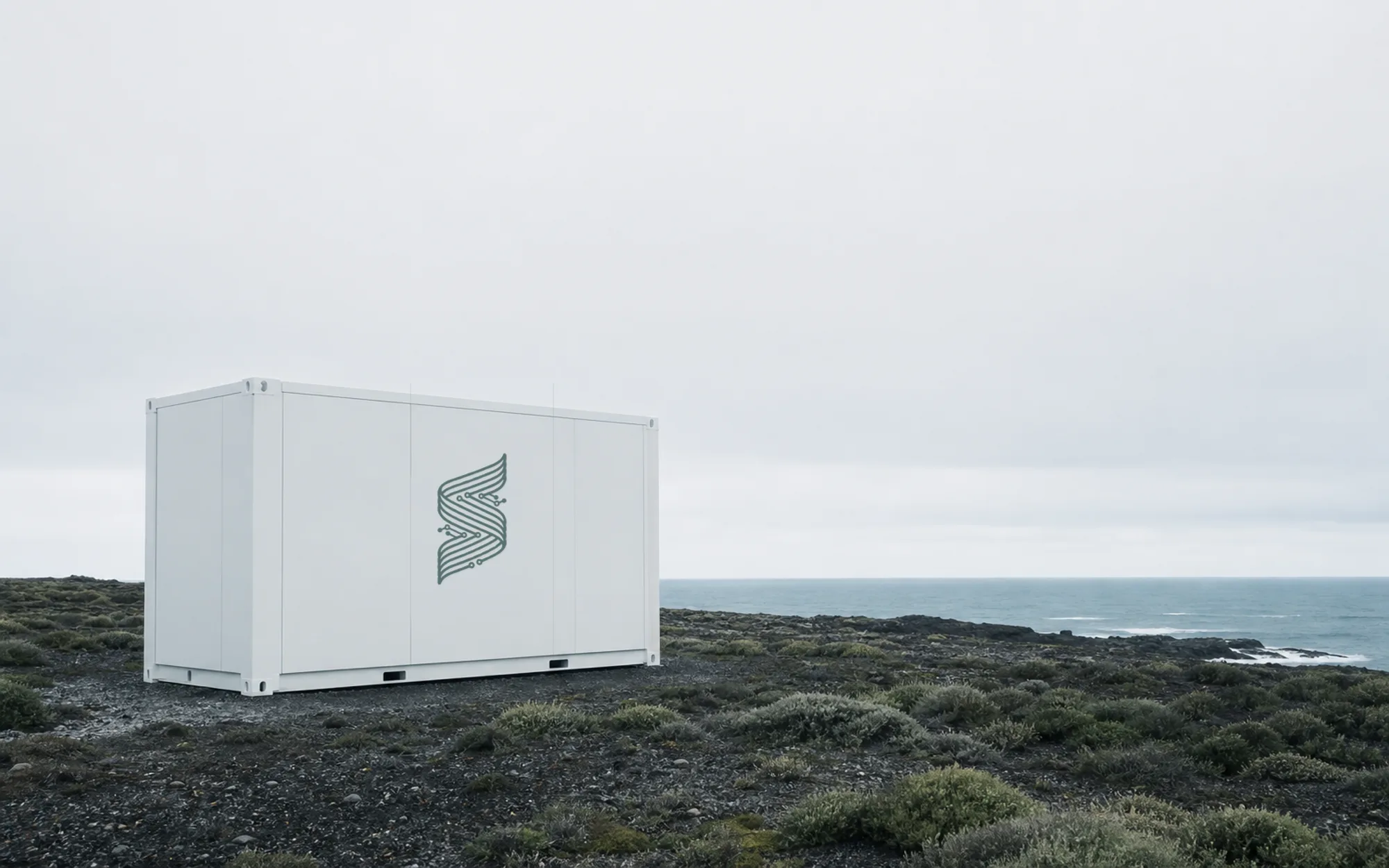 [ concept render · not a built unit ]
 We are early, and we say so.
The claim is not that we have solved duckweed. The claim is that we are building the system that finds out the truth faster, in the real world.
Proof of concept
Where we areWhere we are. Working species-vision detection, a 256-paper knowledge base, and first pilot trials — indoor and outdoor, including pH optimisation.
Protein modelling and vision
Laboratory testing is the real proof, and that is exactly where the work points.
The instrumented system
Sensing, simulation, and harvest concepts are designed to fuse live data. Being built, not yet a closed loop.
Lipid genomics and recovery
Open research questions. We map where the gaps are. Nothing here is wet-lab-validated yet.
Early, and pointed straight at the unlock.
What we've been building.
Field notes, milestones, and short videos will land here as the work ships. There's nothing to publish yet — ask to be kept in the loop and we'll send them as they come.
The firewall is part of the technology.
Biomass that strips metals from dirty water can't also be a clean product. We separate the two routes from the first sensor reading — and that discipline is exactly what lets the clean line go where a partner needs it, high-protein food included, without ever blurring the line.
Non-food, non-feed, by design.
Water-treatment biomass is tracked as its own stream — for energy, materials, or disposal. It never crosses into a clean product.
Clean inputs — food and feed on the table.
Grown on clean water, duckweed can be steered toward high-protein food or feed. That route earns its own methods, validation, and authorisations. We're strict about it — and we don't pretend one system does everything.
Containment, traceability, and candour come first.
- Never sell or blend remediation biomass as food or feed.
- No outdoor-release narrative.
- No unproven health or medical claims.
- No unproven performance or nutrition numbers on the public site.
The research agenda is the invitation.
We point our own AI at the indexed literature to find where the science is thin or missing — the white spaces worth a real experiment — and fuse sensor data with CAD models to simulate how light actually reaches the mat, hour by hour, before anything is built. The questions below are where we're looking to go further with partners.
How does local water change the system?
A partner's contaminants, nutrients, and treatment goals define the experiment — before any downstream route is on the table.
What survives the move outdoors?
The lab shows what the plant can do. The field asks what it does here — under this climate, this water, this constraint.
Which levers actually shift what it makes?
Duckweed is no natural oil producer, but stress moves its composition. AI-assisted comparative genomics helps us find candidate levers; the bench decides what's real.
What becomes of the biomass?
Non-food biomass has valuable second lives — including as a precursor for carbon materials. Every route stays firewalled from anything clean.
The team is growing. Come build duckweed for the real world.
We investigate all sorts of parts of duckweed — the water, the plant, the sensors, and the systems around them. As the work grows we're looking for people who want to work on it directly, across disciplines.
Systems & construction
Designing and building new systems for cultivation — the hardware that takes duckweed out of the lab.
Systems engineering & AI
Making sensor data more reliable and accurate with AI — the backbone of an adaptive system.
Biologists, chemists & more
Scientists to push the research — the depth that keeps the system honest as it scales.
Positions in Spain, with remote possibilities. To apply, send a short note and your CV to careers@seraph-technologies.com.
We also collaborate with the Ex Venture internship programme in Bali — explore it here ↗.
The idea is here. The data lives behind a real conversation.
Use the same door. We route by role, then share the right level of detail under the right conversation.
Research agenda
Wet-lab, water, and engineering collaborations around open questions.
Governance and TRL
A responsibly scoped approach to taking duckweed out of the lab, with a strict firewall between remediation and clean production.
Optionality and maturity
A compounding data system with both clean and non-food downstream paths, and an honest maturity ledger.
One form, routed by role.
Tell us who you are and what you're working on. A real person reads it and replies — no bot, no autoresponder — and your enquiry reaches the right desk.
We use what you send only to respond to and route your enquiry. See the privacy notice for how your data is handled.