Duckweed and Phosphorus: How Much the Plant Really Removes
Duckweed and phosphorus, from uptake to harvest: how much P a frond holds, why starved plants absorb faster, and how much pond P loss is the plant.
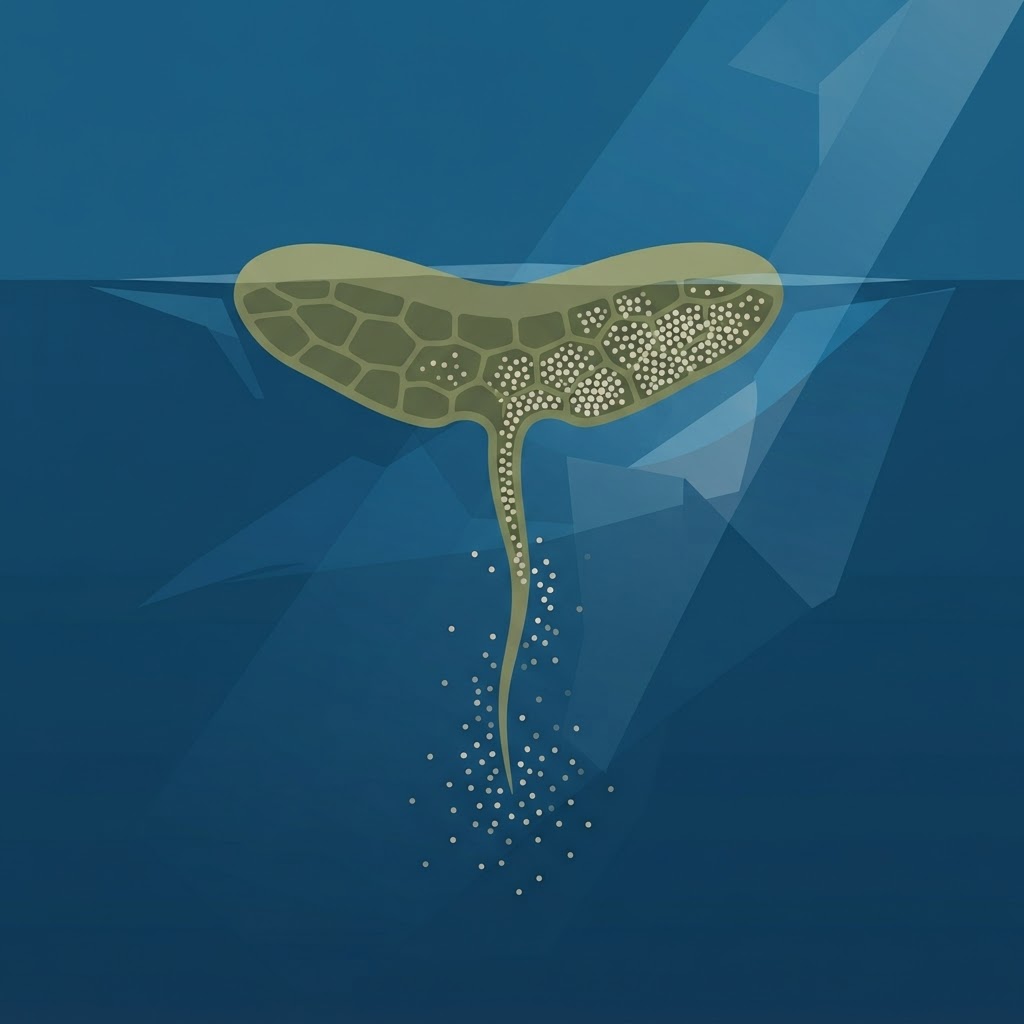
Duckweed and phosphorus get mentioned together in almost every paper on duckweed water treatment, usually as one removal percentage next to nitrogen. That percentage hides three questions. How does a frond take phosphate out of the water? How much can it hold? And how much of the phosphorus a pond loses actually ends up in the plant, as opposed to the algae, the biofilm and the sludge?
The literature answers all three, just never in one place. This article puts the pieces together. The short version: duckweed takes up dissolved orthophosphate and stores it, a hungry plant takes it up much faster than a well-fed one, and nothing leaves the pond until someone lifts the plant out.
Duckweed and phosphorus: the short answer
Three numbers frame everything below. Duckweed tissue holds roughly 1 percent phosphorus by dry weight. Uptake does not depend on growth, so a plant that has stopped growing in the cold can still pull phosphate from the water. And depending on the system, the plant’s own share of a pond’s phosphorus loss has been measured anywhere from under a third to about three quarters, with the rest going to algae, bacteria and sediment.
Each of those numbers comes from a specific study under specific conditions. They are not design values, and the sections below keep them tied to where they came from.
How a frond takes up phosphate
Duckweed takes phosphorus up as dissolved phosphate. Organic phosphorus in raw wastewater has to be mineralised by bacteria first, which is why the treatment train matters. The companion piece on what happens to the water inside a duckweed treatment pond walks through that sequence.
Two transport systems, one for scarce phosphate and one for plenty
A study of Lemna under temperate conditions measured radiolabelled phosphate uptake across concentrations of 0.05 to 12.4 mg P per litre and found two modes. A high-affinity system, Km 21 micromolar, works at low concentrations but slowly. A low-affinity system, Km 510 micromolar, moves phosphate roughly 700 times faster at its maximum. In practice the plant has a scavenging mode for clean water and a bulk mode for effluent, which is why removal runs faster at higher starting loads.
pH changes the rate
Older physiology work on Lemna gibba found that phosphate enters by cotransport with protons, with the uptake rate optimal at pH 6 and falling as pH rose. The temperate study reached a slightly different conclusion in its own setup, finding neutral pH and nitrate as the nitrogen source best for both removal and storage. The two are not contradictory so much as measured in different conditions. The practical point holds in both: the alkaline water of an algae-dominated pond is a bad place for duckweed to take up phosphate.
How much phosphorus a duckweed frond holds
A Utah State thesis on the Wellsville municipal sewage lagoons found that duckweed contains on average 1 percent phosphorus on a dry weight basis and, in microcosms under 200 micromoles of light per square metre per second, removed 113 mg of phosphorus per square metre per day.
That 1 percent is not fixed. In one of the oldest studies on the subject, plant phosphorus rose with the phosphorus in the sewage effluent up to 2.1 micrograms per millilitre. An outdoor mesocosm in Ireland found 7.99 mg of phosphorus per gram of duckweed in aquaculture effluent, against 10.95 mg per gram in an earlier, denser stand on richer water. The frond’s phosphorus content is a reading of the water it grew on and of how crowded the mat was.
Luxury uptake: a starved plant absorbs faster
The most useful finding in the phosphorus literature for anyone designing a system is that uptake depends on what the plant has already stored.
Duckweed can store phosphorus beyond what it needs for immediate growth. A Dutch competition study showed that Lemna minor and gibba perform luxury phosphorus uptake: internal phosphorus rose within two weeks of a deficit ending, without a strong increase in growth, and plants with a phosphorus-rich history kept growing even when moved to low-phosphorus water.
The reverse also holds. Within 12 hours of being moved to phosphorus-deficient medium, Lemna and Spirodela increased their phosphate uptake rates by 30 to 120 percent, through a two to fourfold increase in maximum transport capacity rather than better affinity. The plant builds more transporters when it runs short.
The temperate Lemna study turned this into a design idea. The rate at which plants removed phosphorus correlated with their internal phosphorus at transfer with an R squared of 0.95, and plants pre-acclimated to 1 mg P per litre removed phosphate quickly even at 8 degrees Celsius and a 6 hour photoperiod. The authors proposed a deliberate phosphorus starvation stage, plus a design in which biomass moves from low-phosphorus to high-phosphorus water, against the direction of the liquid flow.
A UK doctoral thesis tested the same lever. After acclimation to low phosphorus, duckweed took phosphate from 15 mg per litre to below 0.1 in four days under simulated UK summer and winter conditions.
How much phosphorus a duckweed cover actually removes
Here are the headline numbers, each with the conditions that produced it.
| Study | Setup | Phosphorus result |
|---|---|---|
| Utah State thesis | Lab, continual harvest, 46 day retention | 3.88 to 5.2 mg TP per litre down to 0.16 mg P per litre |
| UK thesis (Paterson) | Two tanks in series, 2 day retention each, continuous flow | 10 mg P per litre down to below 0.2 |
| Sutton and Ornes | Static secondary effluent, 8 weeks, half harvested weekly | 97 percent drop in orthophosphate |
| Xu and Shen | 6 percent swine lagoon water, 8 weeks, harvest twice a week | 89.4 percent of total phosphorus removed |
Read the setup column before the result column. The static trial reached 97 percent while its weekly yield fell from 28 to 4.6 grams per square metre, so much of that drop came while growth was collapsing. The swine lagoon trial diluted its feed to 6 percent and needed 60 percent of the surface stocked from the start to keep algae out. The UK thesis reports the low outlet concentration from indoor mesocosms, and its outdoor pilot was preliminary: the thesis states that changes in the real wastewater profoundly affected the process and that time ran out before a full study. The wider evidence on duckweed on manure effluent shows the same pattern at larger scale.
The plant is only part of the phosphorus budget
A pond that loses 90 percent of its phosphorus has not put 90 percent of it into duckweed.
The review by Körner, Vermaat and Veenstra found that the duckweed mat, together with its attached bacteria and algae, accounts for three quarters of total nitrogen and phosphorus loss in very shallow systems. That is the mat as a community, not the plant alone. It is also the reason the same review recommends shallower ponds than the literature usually uses.
When the plant was separated from the rest, its share shrank. In the Irish mesocosm, which started at 50 percent duckweed cover, the plant accounted for 29 percent of the phosphorus removed and phytoplankton for 38 percent, with the biofilm playing no major role. The authors cite earlier small-scale work in which duckweed removed up to 54 percent of phosphorus, depending on initial plant density.
The phytoplankton share does not count as treatment. Algae cannot be harvested easily, and the phosphorus they hold goes back into the water when they die. With an incomplete cover they also compete hard: in co-culture, algae drew phosphorus below 0.01 mg per litre, beneath the minimum duckweed needs, pushed the pH above 10, and the fronds lost 87 percent of their phosphorus.
The same mechanism, run the other way, explains why a full duckweed cover wins on phosphorus. A pilot comparison of duckweed and algae ponds in series found that total phosphorus was reduced more effectively in the duckweed ponds in both seasons, and attributed that to uptake by the plant followed by its removal through harvest.
Phosphorus saturates before nitrogen
Phosphorus and nitrogen do not leave on the same schedule. In flow-through duckweed reactors, phosphorus removal peaked around day 5 and fell toward zero between days 12 and 20, while nitrogen removal was still climbing. The sibling article on duckweed wastewater treatment explains why phosphorus saturates first and what that means for retention time. The uptake physiology above suggests one likely reason: a plant with a full phosphorus store takes up phosphate more slowly than a hungry one.
Cold water: growth stops, uptake does not
The usual assumption is that duckweed treatment belongs in the tropics because the plant barely grows in a temperate winter. The phosphorus data complicate that. The temperate Lemna study found significant phosphorus removal and storage at 8 degrees Celsius with a 6 hour photoperiod, conditions under which growth did not occur, and could still measure phosphate transport at 5 degrees. It notes that a duckweed pond of about 4 days retention compares with about 14 days for an algal pond, or with the running cost of chemical precipitation.
The swine lagoon trial saw the same thing outdoors in a milder form: substantial winter removal despite limited growth, partly credited to the biofilm on fronds and tank walls.
None of this makes winter a solved problem. The Utah thesis set its harvest window from full cover in mid June to mid September, ending when temperatures fall below 15 degrees, because in autumn the plants switch to forming turions for winter. Uptake without growth also has a ceiling: a plant that cannot add biomass can only fill the store it already has.
Harvest is the only exit
Phosphorus inside a living frond is still in the pond. When the frond dies and sinks, it releases the phosphorus again. The only point at which phosphorus physically leaves is when biomass is lifted out.
The Utah thesis put numbers on that for one real lagoon. For Wellsville, operating at 0.547 million gallons per day with 5 mg TP per litre, it estimated that biweekly harvests at a starting density of 75 grams of dry duckweed per square metre would remove enough phosphorus to meet the city’s 432 kg per year discharge permit, until flow rose above 0.656 million gallons per day. That is a design estimate, not a measured outcome, but it shows the right framing: the permit is met by harvested mass, not by percentage removal.
Where the harvested phosphorus may go
Several studies above describe the harvested plant as a resource, either as feed or as a route to phosphorus recovery and reuse. For biomass grown on sewage, manure or drainage water, the feed half of that framing is off the table. SERAPH’s published accuracy guide states that remediation biomass is never sold or blended as food or feed, and that the production and remediation streams are separated from the first sensor reading.
Whether that biomass can return its phosphorus to land is a separate question with its own rules on contaminants. It is covered in the planned piece on whether duckweed can be used as fertilizer, not assumed here. Phosphorus that settles into the sediment instead of the plant leaves with the sludge, and the engineered routes for phosphorus recovery from sewage sludge are a separate field with its own technology.
Where SERAPH is on this
Everything above is a reading of published studies, not a report from a SERAPH system. The company states its own maturity as TRL 3, proof of concept, with outdoor field validation still ahead, and it does not publish performance figures.
What SERAPH works from is a map of the evidence: 256 duckweed papers across 31 research areas in 5 domains. The phosphorus area is unusually deep on mechanism and unusually thin on field data. The starvation effect and cold-water uptake were both measured indoors, and the one outdoor temperate pilot above stopped short. That gap between the bench and real water is the one SERAPH is built to close. AI proposes, the bench validates.
FAQ
Does duckweed need phosphorus to grow?
Yes. Lemna growth is limited by both nitrogen and phosphorus. Because the plant stores phosphorus, a stand with a phosphorus-rich history can keep growing for a while on low-phosphorus water, drawing on its reserve, while a stand that grew up short of phosphorus grows much more slowly on the same water.
Will duckweed lower phosphorus in a garden pond?
Only if you take it out. Duckweed moves phosphorus from the water into its fronds, and dead fronds return it. Skimming and removing the plant is what lowers the pond’s phosphorus. The broader question of whether duckweed cleans ponds has its own answer.
Is duckweed or algae better at removing phosphorus?
Algae can draw phosphate lower in the water, but they are hard to harvest and release it again when they die. A full duckweed cover shades algae out and can be lifted off, which is why duckweed ponds cut total phosphorus more than algae ponds in a pilot that compared them across both seasons.
Can duckweed replace chemical phosphorus precipitation?
Not on current evidence. Laboratory and mesocosm studies reached outlet concentrations below 0.2 mg P per litre, and one temperate study suggests duckweed for small rural works as an alternative worth exploring. No outdoor temperate system in the sources above has yet shown it holding a permit through a full year.